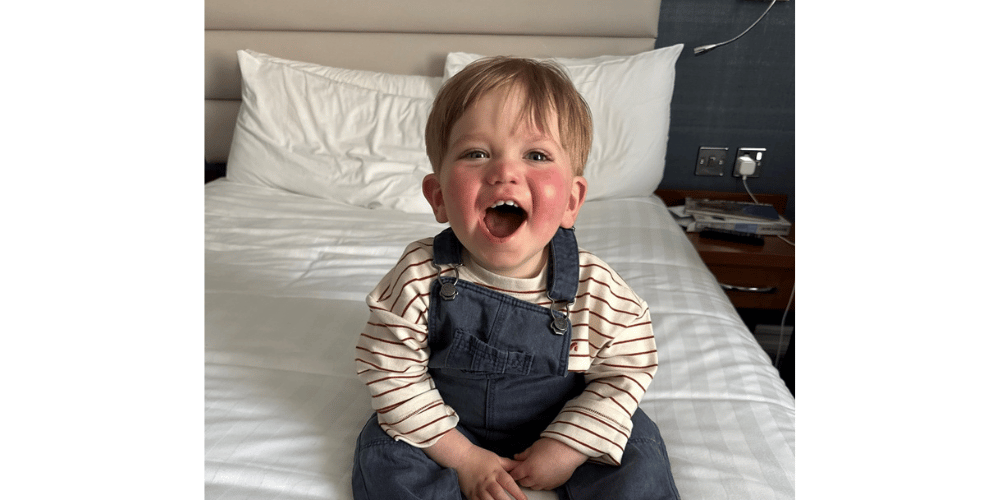
When Bobby’s family arrived at Helen & Douglas House, they were exhausted after months of hospital stays, difficult decisions, uncertainty and heartbreak. In Bobby’s final hours, the hospice provided expert care, practical support and, most importantly, a peaceful space where the family could simply be together.
Today, Bobby’s parents, Faith and Calum, are sharing their story to help ensure other families can access the same compassionate care when they need it most.
To give back to the hospice that supported them, Faith and Calum are also taking on the Oxford Half Marathon this October.
A search for answers
Bobby was a happy, healthy and cheeky little boy until he became seriously unwell at just 16 months old. What started as recurring infections gradually became more concerning when he lost the ability to walk and crawl. Despite repeated visits to doctors and hospitals, nobody could explain why he wasn’t getting better.
“I’m a primary school teacher, so I know children get viruses and get ill,” says Faith. “But I was back and forth to the doctors every two weeks. We kept being told it was an ear infection or something else, but it never went away.”
Six months after Bobby first became ill, a family holiday highlighted just how much his condition had deteriorated.
“We returned home really worried,” recalls Calum. “An ENT specialist at the John Radcliffe Hospital in Oxford agreed to fit grommets, but during the procedure he was concerned by the severity of the infection he found. Blood tests were taken and the next day we got a phone call asking us to come back in.”
The news they received changed everything.
“As soon as we walked into the room, we knew it was serious. There were six or seven
specialists introducing themselves. We realised straight away this wasn’t something
that could be treated with antibiotics. From that day, we didn’t leave hospital for 12
weeks.”
A rare diagnosis
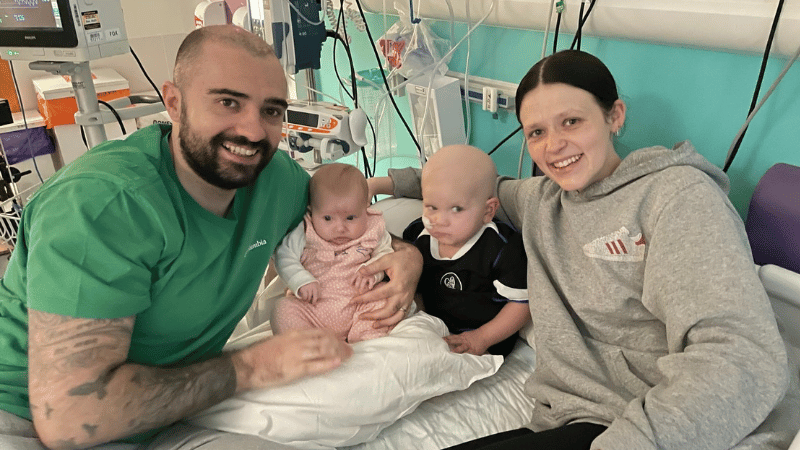
A brain MRI scan revealed that Bobby had encephalitis, a severe inflammation of the brain. Doctors also discovered he had enterovirus, a common virus that would rarely cause such serious illness.
Seeking answers, immunologists from Great Ormond Street Hospital carried out extensive genetic testing. The results revealed that Faith and Calum were both carriers of an extremely rare genetic condition called RAG1 Severe Combined Immune Deficiency (SCID). Bobby had inherited the condition, meaning his immune system was unable to fight off infection. As a result, the virus had spread to his brain.
At the same time as coming to terms with Bobby’s diagnosis, Faith and Calum were preparing for the arrival of their second child.
Holding on to hope
Doctors discussed palliative care as one option. The alternative was a bone marrow transplant, which could effectively give Bobby a new immune system.
“The decision was made to wait until Betsy was born because there was hope she might
be a donor match,” says Calum.
When Betsy arrived, tests confirmed she did not have SCID. Sadly, she was not a suitable donor.
“We had two weeks together as a family at home before Bobby and I went to stay at Great Ormond Street Hospital,” Calum recalls.
Bobby underwent chemotherapy before receiving a bone marrow transplant, with Calum acting as his donor. For months, the family was separated between home and hospital, with Calum caring for Bobby in London while Faith looked after newborn Betsy. Initially, the transplant seemed promising. Then Bobby’s condition began to deteriorate.
“I remember saying to Faith, ‘Bobby has changed’,” says Calum. “He was always such a
cheeky little boy. He loved the attention from the nurses and would steal their pens from their uniform pockets. But suddenly I couldn’t see his personality anymore.”
A few days later, Faith and Calum made the heartbreaking decision to move Bobby to palliative care.
Coming to Helen & Douglas House
“Being at Helen & Douglas House, I feel like we went into a space of calm, and I think that was felt by Bobby too.” Faith, Bobby’s mum.
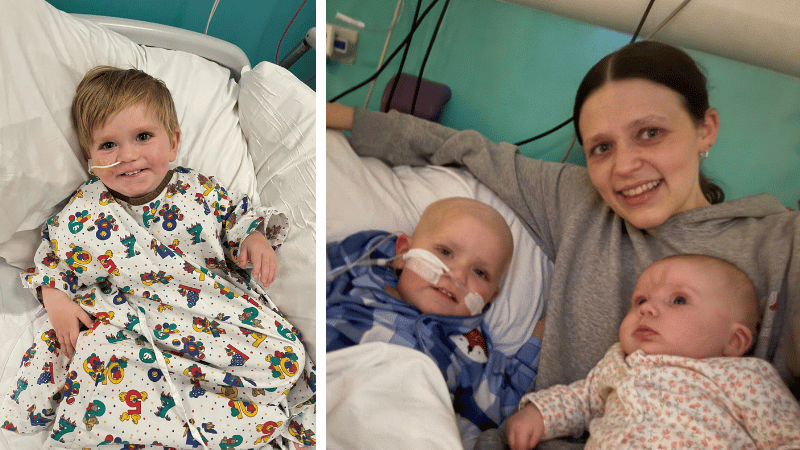
On 16 December, Bobby and Calum travelled by ambulance directly from Great Ormond Street Hospital to Helen & Douglas House. Faith arrived first with baby Betsy.
“I remember pulling up and ringing staff in tears because I didn’t know where to park and Betsy was screaming for milk,” she says. “A gorgeous nurse came straight out, got into the car with me, helped me park and carried everything inside. She even found someone to feed Betsy.”
“From that moment, Helen & Douglas House wasn’t just caring for Bobby, they were looking after all of us.”
The family were able to stay in a family room, with Bobby next door, so they could spend precious time together.
“The play team took handprints with Bobby and Betsy and everything just felt homely. We were finally the four of us together.”
“Calum and I were able to be together with Bobby, reading The Gruffalo’s Child and listening to stories on the Toniebox. A short time later, his breathing changed and he passed away peacefully.”
Bobby died a few hours after arriving at Helen House, aged two.
Looking after the whole family
Following Bobby’s death, the hospice team continued to support the family in every possible way.
“The nurses were amazing,” says Faith. “They stayed with Bobby the whole time, changed his clothes and carried him to the Little Room.”
The Little Room is a dedicated cooling room where families can continue spending precious time with their child after they have died.
“It’s hard to describe how much it meant to us,” says Calum. “Faith and I hadn’t slept in the same bed since June, but being at Helen & Douglas House made us feel like a normal husband and wife again. It felt like we had a space that was ours.”
Faith adds, “I remember saying to the team when I arrived, ‘all I want is for Calum to be a dad, I don’t want him to have to be a carer’ because he’d been doing that for months alone in hospital. And that’s exactly what the doctors and care team at Helen & Douglas House gave us.”
The family spent time in the sensory rooms with Betsy, walked in the gardens and spent precious time with Bobby. Staff also helped arrange practical matters, including contacting a funeral director and coordinating arrangements.
Most importantly, the support continued long after the family left the hospice.
“We’ve received bereavement support, phone calls and visits in the weeks and months that followed,” says Faith.
“They were there during our most vulnerable time of need,” adds Calum. “And now we want to support other families so that when they need help, the hospice is there for them too.”
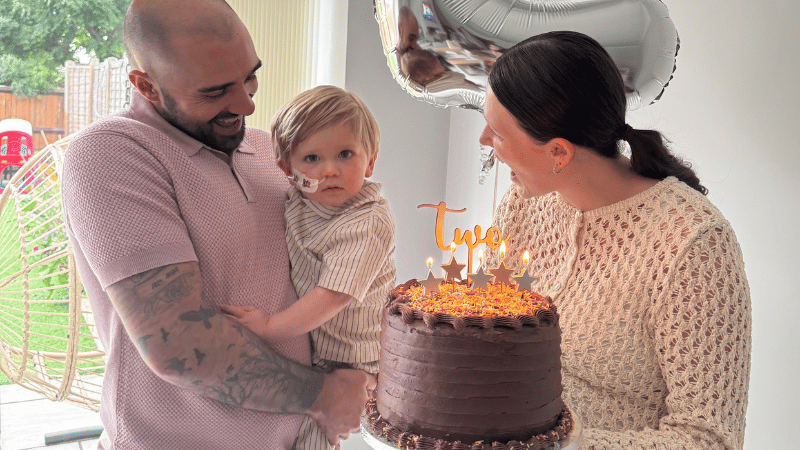
Running for Bobby
To give back to the hospice that supported them, Faith and Calum are taking on the Oxford Half Marathon alongside Bobby and Betsy’s godparents. What started as a passing suggestion has become a team of six running in Bobby’s memory.
“I haven’t really done much running before,” laughs Calum. “I’m more of a gym goer, so I think I went a bit too hard at the beginning and picked up an injury. But I’ve built myself back up and I’m feeling positive.”
“On race day, I think it will feel like Bobby is there with us. We’re doing this in his honour, and being surrounded by people who have also been supported by Helen & Douglas House will help us feel closer to him.”
An invaluable lifeline
“Even if just one child in my school or a parent recognises the name Helen & Douglas House and knows that they were there for Bobby and all of us, then we’ve done our bit.”
For Faith and Calum, Helen & Douglas House will always represent far more than a hospice.
“It isn’t just the medical care they provide for the child who is poorly,” says Faith. “It’s the holistic care they provide for the whole family. From making sure we ate, to looking after Betsy for a little while, we were all cared for. For so long we were just trying to survive. At the hospice, we were seen.”
The family’s connection with the hospice continues today through remembrance events, ongoing support and opportunities to celebrate Bobby’s life.
“What Helen & Douglas House gave our family, and continues to give our family, can’t really be measured,” says Faith. “You never feel forgotten. Bobby’s name is in a memory book, we’re invited to family events and people still check in on us. I know if I picked up the phone tomorrow there would be support there.”
“What Helen & Douglas House means to our family is invaluable.”